Dr Richard Calis
Richard Calis is an Assistant Professor in history at Utrecht University, specialised in cultural history of the early modern period (1500-1800). He obtained his PhD in history at Princeton University in the United States in 2020. For his PhD research, titled The Discovery of Ottoman Greece he focused on the life and works of Martin Crusius, a sixteenth century scholar who wrote about Ottoman Greece from a Western European perspective. Richard used Crusius to understand how people in the early modern period thought and wrote about cultural and religious differences.
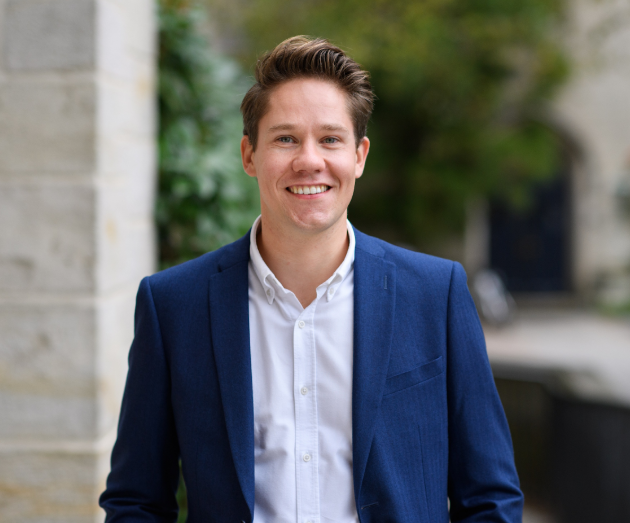
Richard’s most important advice
If there is one bit of advice that I can give to anyone who wants to do a PhD: don't network with just anybody for the sake of networking, but if there are people you like as a person at your university, people you like as a teacher, people whose articles you enjoy reading, talk to them! Explain that this is what you want and if they have advice. I think these are the people you are looking for to help you in this process, and they can also really help to demystify it for you. Speaking from experience, I love hearing from students! Not everyone in the academic sphere does, but I think lots of my colleagues do.
Avoid wanting it too much, that would be a little bit of my advice for what ‘not’ to do. For one, there are so many fulfilling jobs out there in which you can do research and make an impact which is not academic work. In my opinion, people who are research MA students today may romanticize doing a PhD a little bit. It’s fun to do research, but you're also producing a dissertation that hopefully will become a book, and depending on how you write, it may have or may not have a limited readership. You can also do very fulfilling work in a museum or in other professions. I think if you focus too hard on getting your PhD, you'll be disappointed, because ultimately you will get so many rejections. You apply for grants, you get rejected, you apply for postdocs, you get rejected, you apply for jobs, you get rejected. And that’s normal in life, right? But if you self-identify too strongly with your work, any of these rejections can feel like a rejection of you as a person. Learning to separate the two is necessary, but very difficult if you are too invested in it.
If you're interested in a broad area of topics, that’s very much to your advantage. Reading helps a lot with this! I think what makes me and my work interesting is that I don't only read academic material. I also read fiction, and I love reading other things. Reading will improve your writing, it will improve your analytical skills, it will make things more fun. Read in fields that are not necessarily your own. For example, I read a lot on food history, and I teach a course for the Humanities Honours Programme on heritage in Berlin, even though it is not my research topic. I also think learning a language is always good! If you're a historian like me, knowing a language really well allows you access to different sources and an entirely different academic climate, something that can really set you apart! Knowing another language is so helpful in that it opens doors and allows you to communicate with a lot more people within the Humanities. I think it's important to be attentive to these things, and I feel it makes me a more rounded scholar, something that can really set you apart from other people.
Don’t get too distracted by grades. I fundamentally believe that if you focus on the process, the grades will come. Students today are so focused on grades and not on the process of learning something in general, though I know there are exceptions. I think grades are the worst thing in the whole academy. They don't tell us anything about a student, because we're just focusing on a singular moment and not on someone’s learning trajectory. When I was still doing classics, one of my professors told me that “you become a classicist in the pub.” That is fundamentally what I think is true. Read for seminars, go to seminars, go to lectures; but also talk to your friends about what you're reading, talk to your colleagues about what you're thinking, go to museums, do everything that's connected to your field. Don’t be afraid to use your time just to think, and be inspired to talk to people. That’s how you can truly grow as an academic and as a person in general.
For your PhD research topic, I would advise you to do what you like. Of course this should be within reason. Be attentive to what people in your field are doing: there are often current trends which will get you funding easier than other topics. So that's important, but also stick to what interests you: only research something when you think it's actually fun. The second most important step to getting a PhD is to find a good supervisor who you like as an academic and a person, someone who will allow you to shine! However, it's important to note that when I hire someone, I also want someone who I know will do the work. So it’s a bit like dating, it needs to click from both sides.
Lastly, there is no shame in trying and only afterwards finding out something isn’t for you. This advice, which my mother gave me when I started out with my PhD, is something I fundamentally believe in to this day. Some people I know followed a PhD and loved it, but didn’t pursue an academic career afterward. Some found out the path to a PhD really wasn’t for them only after getting accepted, while others like me only found out it was right for them during the process! If you try and put in the effort, you'll figure out if it's for you or not.
How did you start with your PhD and why?
Because of chance, and I didn't know what else to do, that's the honest answer.
I started off as a classicist studying Latin and Greek, and then I transitioned during my research MA to history. Part of this programme was to write a PhD application. I always envisioned myself as a (high school) teacher, but through factors outside of my own control I couldn’t follow up with a teaching MA. I had a PhD proposal lying around so I submitted it in the Netherlands, but it was turned down. My professor at the time (Guy Geldener) advised me to try it again in the United States. For a year I worked partially as a research assistant in Utrecht and as a tutor for high school kids. I wrote my application, submitted it to various UK and US institutions and to my own surprise got accepted by Princeton University.
Before this, I never planned on doing a PhD: It was simply something that came along at the right time. I'm the first of my family to attend university, so I didn't really know what doing a dissertation was or doing a PhD was. Everything in my case kind of happened by chance, including the fact that I did it in the US.
Was it easier to get accepted for a PhD position in the US, then?
No, so I think it was way more competitive than the Netherlands. I got into Princeton to do my PhD, which has a 4% acceptance rate, which is very low. Although I put in the work to get accepted myself, I was also very lucky that I had people around me who supported me. Multiple people who knew my supervisor in the US wrote letters of recommendation, so I had a much greater chance of getting accepted because my supervisor was aware of people who could vouch for me.
For the application process, I was really, really lucky. I didn't know at the time that I had lots of people around me who were willing and able to support me. This is not to say that the process of application is nepotism all around, but I think everybody needs a little bit of help. Also, ultimately, there's no right or wrong or one way to do it. You can plan everything perfectly, get your desired position and then be disappointed. So if you stick to who you are and what you like most, that is ultimately way more important.
What happened after getting accepted?
It was pretty hectic! I got an email congratulating me for getting accepted. Then two weeks later, I got an email that said my acceptance offer had been denied. I felt like they ‘discovered’ I wasn’t good or smart enough. However, it turned out they made a mistake, and as a result they gave me more money and in turn an extra scholarship. So this whole process was pretty nerve-racking, chaotic and I didn't know what to do. Even after getting accepted, I struggled a lot with imposter syndrome. People around me seemed smarter and more well-read than me and I was terrified that people would ‘discover’ that I knew nothing, something I feel many other students can relate to.
During the actual process I followed a master PhD program, which is standard in the US. So my first few years I did coursework, two courses, and wrote a PhD application of the project I wanted to do. Though it wasn’t required, I really loved teaching, so I did that as well for the first two years. And then for the next three to four years, I did research consisting mostly of archival work and reading secondary literature.
How did you know this was the right choice for you?
Initially, I didn't; I kind of went in head-first. I was totally naive about doing a PhD and moving to the US. It took a huge toll on the personal lives of me and my partner. It was pretty rough at first but I just did it, and it turned out that it was right for me. When I moved to the US and I met my fellow students and started my research, I really enjoyed it. It's fun to do research, to dig really deep into something, and I've always loved reading, learning languages, and traveling. Then all of a sudden all of this was possible as a profession, and it's a total privilege to be able to get paid to do what I love most! But personally, I wasn’t sure if it was the right choice for me before I started. When I was writing my PhD, I didn't really know for sure I wanted to become an academic. I just wanted to finish it and then see what would happen.
How was your relation to your supervisor?
I just applied to someone whose work I liked; I had not met him in person or at all, and I had no idea what kind of person he was, or how he would be as a supervisor. But I was very lucky, and my supervisor turned out to be really phenomenal, better than I could have imagined; he became my adopted grandfather in a way. He did everything that I think a good supervisor should do. He introduced me to people in the field at conferences. He would present me opportunities to speak and review, and often told people to talk to me when they had relevant questions. Supervising is not about the supervisor, although some people tend to think that. It's most importantly about supervising the PhD student in a way to make them shine.
I also saw the other side of that coin: I knew people who cried when they left meetings with their supervisors. There are horrible supervisors everywhere, and I think really the relationship with your supervisor is way more important than doing it at Princeton, or Harvard, or Utrecht, or Oxford, or Cambridge, or wherever. Don’t get distracted by the names of these places; in the end they don't mean anything. What really matters is that you have a supervisor with whom you vibe or with whom you have a good rapport.
How did you handle the pressure of the workload for your PhD? Did it affect your mental health in any way?
I think there are two things that are important. I noticed that lots of people were struggling, but I never experienced any serious mental health issues during this trajectory. This was in part because I had wonderful people around me, both supervisors and teachers and fellow students. Of course there were also people, I can't use the word I want to use, who were a lot less nice. *laugh* But it's really, it was for me doable to deal with these people and the stress and anxiety that came with that because I had enough of a support system in terms of friends, even though I was abroad.
I never experienced any serious anxiety. I did experience stress and stressful periods. The workload at Princeton was also really high. During your MA we had to read way too many books, to the point your work-life balance was totally off. It was a lot of work; I worked during the day, but I also worked at nights and sometimes on the weekends. In hindsight, this was only possible because I didn't have many (family) commitments because I was so far away from most of the people I knew.
I started doing my research, this became more of a work-life balance. This didn’t resemble a nine-to-five for me. When you’re thinking and doing research, you need to be creative, and for me that thought process isn’t tied to a time schedule. Like, when I take a shower, when I’m sleeping or in the gym, all of a sudden it hits me! So the work-life balance was off, I would say, but I think I managed to deal with this because I had a good support system and I really, really enjoyed what I did. If you pick a topic that you like, it's easier to deal with the pressure, at least the stress that comes with the research.
What did you do after getting your PhD? How easy was it to find a job or a postdoctorate?
I think it's very difficult. That's the honest answer. And for myself, there are two answers I can give. For instance, when I did my PhD, I applied to postdocs all over the UK and the US. And they are two of the most prestigious ones. Only one of those I actually got, one of the best postdocs I could imagine, at one of the best institutions. It looks all fantastic on paper, but I applied to ten different positions and I got one. So I had no choice in that sense.
You really have to wait for a job to open up. I think it also depends on the field that you're in. There are fields that just hire more people than other fields. It is usually easier to get a job related to topics that are more ‘current’ in the scholarship and sometimes in society than others at any moment. If we are talking about history, think about the history of slavery, colonialism or the environment. These are topics that people are very interested in because they are very important, but have been neglected for so long. I'm not saying they're more relevant because they're definitely not. I think all research is relevant to society in some form or shape. For me, it was a difficult search because I had to find a job in early modern history. I was lucky in that sense that a position opened up. But it is very, very difficult. I also applied for other jobs, academic and non-academic and I didn't get one other than the job that I currently have.
I do think, if I may add one more thing, that this is not something you should be concerned about. In my opinion you shouldn’t do a PhD to get an academic career, but because you want to do it. It should be an investment in yourself, a good investment in your time, and you will learn skills or knowledge, acquire knowledge that will be relevant to any future endeavor. And if you're lucky, you'll get a postdoc or an academic job, but that is not up to you. There's very little you can do to shape that process. I know excellent people who have gotten excellent postdocs but don't have permanent jobs, simply because there’s not enough permanent jobs for all the good people that are around.
Should you do a PhD directly after your studies or would you recommend having some experience in a work field as well?
I think it can work either way. I would have enjoyed a little bit more time just working at another job, because now I don't really know what it is like to work in a different field. When I applied for jobs and also for non-academic jobs, I was always terrified. I kept thinking to myself, ‘I’m okay at doing research and I really enjoy it, what if I take on a different job and I suck at it?’ I think if you’ve done your PhD and you're doubting whether you want to continue in the academy, it's helpful if maybe before your PhD, you've already worked for two years, maybe somewhere like a city council, because then you also know what the alternative is.
What would you look for in a PhD student?
If I’m going to hire a postdoc, I don't care about their grades. I want to know what they think, I want to know how their mind works. I want to know what they've read, what they're reading, so I always ask for a writing sample. Because something like a writing sample tells me way more than whether they obtained a certain grade for a mandatory course in Literary Studies. Students today are so focused on grades and not on the process of learning something in general, though I know there are exceptions. I think grades are the worst thing in the whole academy, and it doesn't tell us anything because we're just focusing on a singular moment, not on someone’s learning trajectory.
I think when I want someone, I want someone that I can also help grow. So you want someone who maybe starts here, ends here, like, who really grows, rather than someone who thinks they already know everything. I have no way to hack the system other than the advice that I gave, but I also think in general just don’t focus too much on grades. One of my professors always said when I was still doing classics, “you become a classicist in the pub.” And that is fundamentally what I think is true. Seminars are relevant. Read for seminars, go to seminars, go to lectures. But also talk to your friends about what you're reading, talk to your friends about what you're thinking, go to museums, like, do everything that's connected to your field because it will make you a richer person and a greater thinker. If you want to write, I think this is an opportunity where you have so much time on your hands to do what you want, of course within the constraints of having a job to pay for your rent. Don’t be afraid to use your time just to think, and be inspired to talk to people.
I fundamentally believe that if you focus on the process, the grades will come. I do understand that obviously for certain research MA programs you need a certain grade average. I am fundamentally against this for obvious reasons, but I do understand that there's also reality out there, so I'm not being naive here. But if you only focus on the grades, you’ll lose sight of the process and I think the same is true with the PhD position.
You have to have so much luck with funding. And that… of course, if you apply everywhere in every country, I'm pretty sure you'll get something somewhere. But it's really difficult, and it's just, it's so serendipitous, you need so much luck, that even if you do everything perfectly, it might not happen. So that's why I think, like, getting upset about it or fussing too much about it, it's not helpful.
So if you knew what you were in for, would you do it again?
I have asked myself this question many times. And for reasons that will surprise you, I will say no. Intellectually, I would have done it again; I had an amazing time! It's been such a great journey and I really have grown as a person. However, I also think the academy is not the best work environment. There’s a lot of pressure, and I don't think it's always a supportive community. I think we as colleagues can do way more to support one another, to create a positive environment, but that's not necessarily the reason I would not do it.
In the ten years since I started, so much has changed. House prices have gone up and life has become completely unaffordable for a lot of people. Me and my partner had to be long distance for a while, I didn't see my closest friends for a long time, I was away from my parents. For many of these personal reasons, I think I would have enjoyed just any other job, gotten a house, and then just lived my life. I know it may sound very appealing how I did this PhD in the US, did a postdoc in the UK and spent my time everywhere in Italy, Greece and Germany. It all sounds fantastic, but the traveling and the precarity takes a toll on you. In the end, never forget that there are many fulfilling lives other than an academic career.